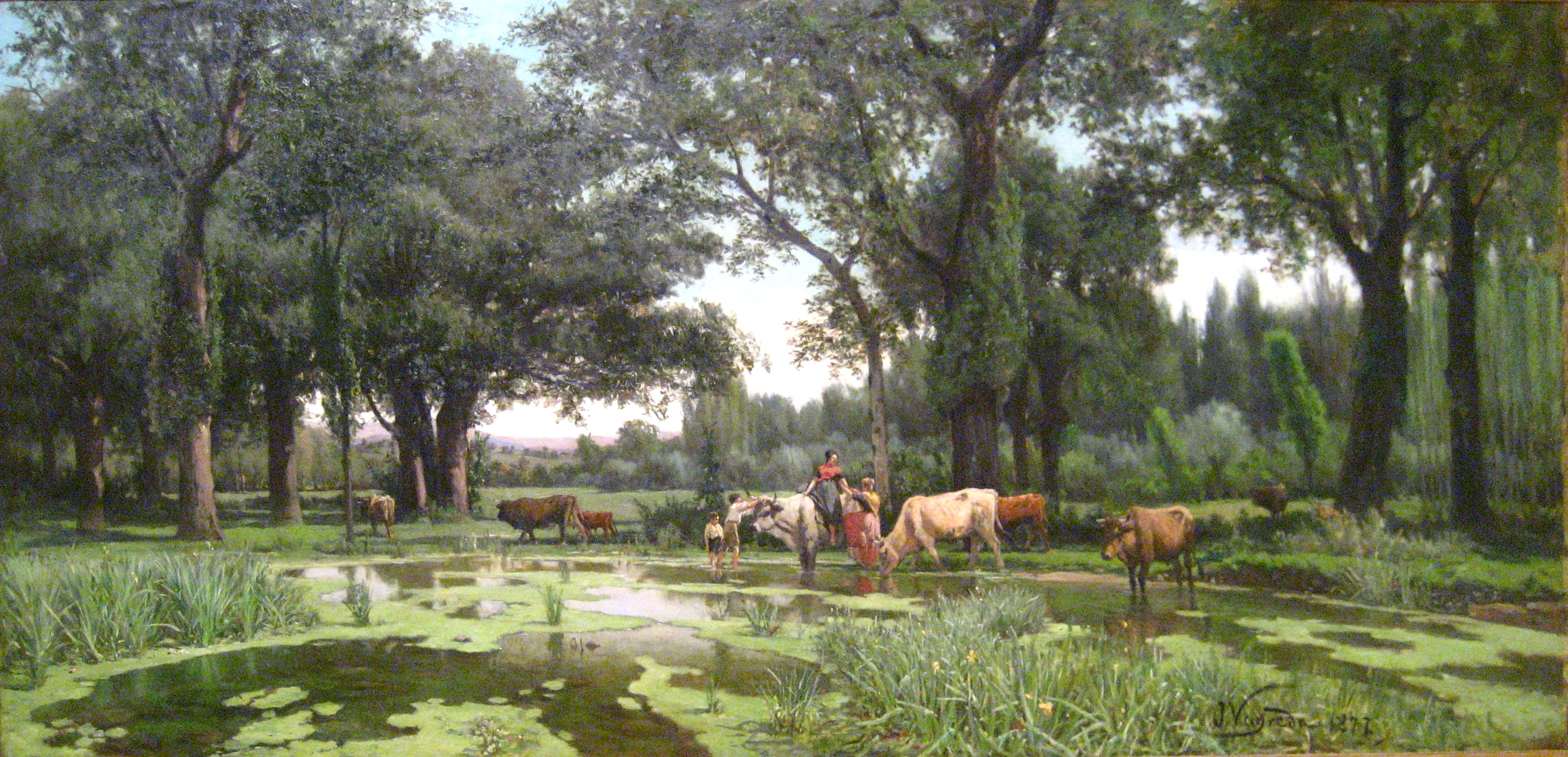
Joaquím Vayreda (1843-1894) is one of the most important figures in 19th-century Catalan landscape painting.
He is the founder of the “Olot School”. This movement developed in the mid‑ to late‑19th century around the town of Olot (Garrotxa, Girona). It was a locally rooted movement focused on landscape painting and rural life, and transformed landscape painting in Spain.
Early Rebellion against Academism
Vayreda was born in Girona, Spain. His family was originally from Olot, they relocated to Girona after their home was destroyed during the First Carlist War. A year after his birth, they returned to Olot to rebuild their lives.
His father, a drawing enthusiast, noticed Vayreda’s artistic talent and encouraged him by having him copy drawings.
At just nine years old, Vayreda began formal art lessons at the drawing school in Olot. In 1860, he moved to Barcelona to study philosophy. He spent his free time learning to paint under Spanish realistic painter Ramon Martí Alsina (1826-1894).
Alsina introduced him to the world of art taught him the basics of realism. But Vayreda found the urban studio stifling. He learned to draw by copying plates and engraved models, according to Vayreda himself, a system “absurd and routine”. He saw nature as more than just a background for history paintings. He viewed it as a subject with its own mood and theology.
In the 1860s, he traveled to Madrid to study the masters at the Prado. Yet, he found the rigid, dry academicism of the Madrid scene stifling. He famously suffered a crisis of confidence there. He felt that the “official” style of heroic and historical painting, had nothing to do with the vibrant, green reality of his homeland.
The turning point of his life was a trip to Paris in 1871. There, he encountered the works of the Barbizon School (Millet, Corot, Rousseau). He was amazed by how these artists painted the humble French countryside. They depicted muddy fields, peasants, and gray sky with the same reverence usually reserved for kings.
He realized that the damp, volcanic landscape of his own home, Olot, possessed the same melancholy beauty. It was a worthy topic for high art.

The “Olot School”
Upon returning to Catalonia, Vayreda retreated to the town of Olot.
This School crystallized around painters who worked en plein air and emphasized faithful, often contemplative depictions of the Olot countryside.
He began to paint the Garrotxa region with a specific, revolutionary approach.
For Vayreda, the landscape was not just scenery; it was theology. He was a staunch Carlist, a traditionalist, conservative Catholic political faction. His landscapes were not just pretty pictures; they were political statements.
He painted the rural, unchanging forests and farms of Olot. In doing so, he celebrated a “pure,” traditional Catalonia, in contrast to the industrial, liberal chaos of Barcelona.
His paintings of peasants working in harmony with nature were subtle political statements about the “true” Catalonia—pious, rural, and unchanging.
His landscapes are often misty, humid and melancholic, featuring soft greens, wet browns, and gray skies. He captured the specific humid atmosphere of the volcanic Garrotxa region. His trees, often beeches or oaks, dissolve slightly into the background, creating a sense of silence and introspection.
Unlike the sharp, sun-drenched realism of his contemporary Mariano Fortuny, Vayreda developed a style based on atmosphere. His mature style is characterized by a “vaporous” quality.
The Gran Encyclopedia highlights Vayreda’s landscape painting. It describes it as “a milestone of the utmost importance in the evolution of Catalan painting”.
Vayreda “introduced a placid, contemplative vision of the countryside and rural life. The authenticity of his vision of the Olot landscape served as an example for generations of young Catalan landscape painters…”, according to the Encylclopedia.
The Olot School transformed the volcanic countryside of Girona. It became the spiritual heart of Catalan art. This transformation was much like what the Barbizon School did for France.
“L’Estiu” and “La Sega”
He rarely painted empty landscapes. His scenes almost always contain small, anonymous figures: peasant women washing clothes, farmers resting, or shepherds. These figures are not the topic. They are painted with the same loose brushstrokes as the trees. The figures are absorbed into the landscape as organic elements, suggesting a divine harmony between man and the land.

“El Arte Cristiano”
In 1880, he founded “El Arte Cristiano” with his brother Marian and friend Josep Berga i Boix. It was a workshop for religious statuary (Sants). This workshop was the first major industry in Olot dedicated to the mass production of religious statuary.
This workshop employed local artisans and sculptors to create plaster and wood-paste statues of saints for churches around the world.
The workshop didn’t just make art. It effectively saved Olot from economic ruin during a recession. The town became a hub for religious art manufacturing, and exported statues globally.
Vayreda had a fascinating dual life that is often omitted from brief biographies. He was both a poetic painter and a factory owner. This strange duality – the misty, poetic landscape painter who ran a mass-production statue factory – defines his practical character.
The irony of Vayreda is noteworthy. The man who painted the most ethereal, silent landscapes was also the CEO of a bustling factory.
A Bridge between Realism and Modernism
Joaquim Vayreda died in Olot in 1894 at the relatively young age of 51, but his influence was massive.
He is considered the bridge between Realism and the burgeoning Modernism, the Catalan Art Nouveau).
Catalan journalist and art critic Raimon Casellas described Vayreda as “a fervent apostle of the open air”. He “initiated among us the art of recording atmospheric agents — air, vapors, light — on the tangible reality of the earth’s envelope”.
He noted that Vayreda “fixed on the space of a canvas the diffuse light that seems to slumber over fresh vegetation; the subtle mist that floats undecided in the air; the breeze that ripples the grasses of the meadow”. He included “the silvery cloud cover reflected in the waters of the lagoon; the watery atmosphere that surrounds the trees, like a nimbus of vapors.”
Vayreda proved that a painter could be modern without being urban and that art could look like the damp, green forests of Girona.
He showed that the gray, wet corners of Catalonia were as artistic as the bright light of Madrid or Rome.
Did you know?
- Joaquim Vayreda and his circle, including his brother Mariàn Vayreda, is widely regarded as the founding figure of the Olot School.
- Spanish landscape painter Josep Berga i Boix (1837-1914) was an important institutional figure. He helped organize teaching and exhibitions in Olot, and directed local artistic life.
- This School crystallized around painters who worked en plein air and emphasized faithful, often contemplative depictions of the Olot countryside.
- These painters were influenced by naturalist and Barbizon tendencies. They emphasise atmosphere (light, mist, air), careful observation of vegetation and terrain, and a contemplative mood rather than dramatic romanticism. Their palette and handling aimed to record local climatic and atmospheric conditions.
- The movement was supported by local institutions. The historic Escola de Belles Arts in Olot played a crucial role. Later, local museums also helped preserve the tradition.
- The Olot painters organized local exhibitions and the school’s work came to be collected by regional museums. The Museu Comarcal de la Garrotxa holds major holdings and exhibitions devoted to the Olot tradition. Modern shows and catalogues keep revisiting the movement’s role in Catalan landscape painting.
More of Joaquim Vayreda
Works of Josep Berga i Boix
Source: the Museu Nacional d’Art de Catalunya, studies on the Olot School, Wikipedia, Gran Encyclopedia
Leave a Reply