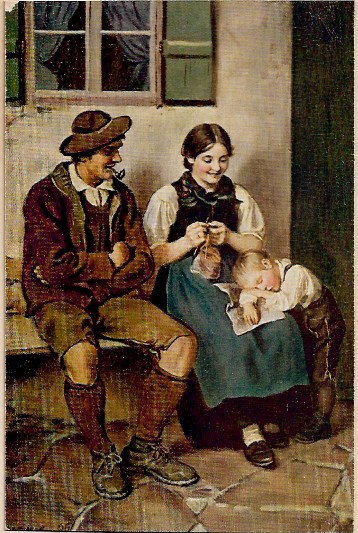
“Feierabend” – Franz von Defregger (1835-1921)
Austrian painter Franz von Defregger (1835–1921) was particularly celebrated for his genre paintings depicting peasant life in his native Tyrol, as well as historical scenes and portraits.
He was a significant figure in the Munich School of painting.2
From Farming to Art
- Franz von Defregger was born on April 30, 1835 into a peasant family in Ederhof, a farm located in Stronach East Tyrol in the Austrian Empire, which is now Austria.
- His talent for drawing was recognized early on, but his first path was as a farmer like his father.
- During his early years, Franz developed a strong love of music, and learned to play the flugelhorn. He soon became a member of a local band, playing at weddings, assemblies, and balls.
- Franz also displayed an early talent for drawing and woodcarving, which he developed autodidactically while working on his father’s farm.
- In 1841, his mother and two of his five sisters died during a typhoid epidemic. He himself nearly died from the fever.
- After his father died in 1858, Franz took over the farm. Within two years he sold it and shared the money with his sisters.
- Defregger moved to Innsbruck where he studied woodcarving with the sculptor Michael Stolz.
- At renowned historical painter Karl Theodor von Piloty’s suggestion, Defregger attended a preparatory class at the Academy of Fine Arts in Munich.
- In the summer of 1863, he travelled to Paris. There, he enrolled at the École des beaux-arts. In 1864, he took part in the Salon des Refusés.
- His study in Paris (1863-1865) was a pivotal period.During this time, he was influenced by the realism of artists like Gustave Courbet. He was also inspired by the meticulous technique of Jean-François Millet.
- Defregger returned to Munich in July 1865 and began studying under von Piloty at the academy. Thus, von Piloty’s influence is clear in Defregger’s narrative compositions and his dramatic lighting.
- In 1878, he became a professor at the Munich Academy of Fine Arts, a position he held until 1910. He was a highly influential teacher, attracting many students from across Europe.
- He received numerous awards and honors throughout his career.
- He was ennobled by Emperor Franz Joseph I in 1883, adding “von” to his name, becoming Franz von Defregger.

Dignity, Simplicity and heroism
Defregger is best known for his genre paintings of Tyrolean peasant life. He depicts everyday activities, customs, and celebrations with great realism. Emotional moments are captured with empathy.
His works often portray the dignity and simplicity of rural existence.
His dedication to depicting Tyrolean peasant life suggests a deep affection for his homeland and its people. He desired to capture their authenticity and resilience.
He painted historical scenes, particularly those related to Tyrolean history and uprisings. These often featured dramatic compositions and strong characterizations.
His historical paintings show an interest in heroism, patriotism, and the struggles of his people.
He is an accomplished portrait painter, capturing the likeness and character of his sitters, often with a psychological depth.
His work is characterized by a masterful handling of light and shadow (chiaroscuro), rich color palettes, and strong compositional structures.
His style evolved, moving from an earlier, more detailed realism to a broader, more atmospheric approach in his later years.
His work was highly popular and widely reproduced.
Among his famous works are Das letzte Aufgebot (The Last Summons/Levy) (1872), and Der Zitherspieler (The Zither Player). He also created Heimkehr der Sieger (Return of the Victors). There are many portraits of prominent figures and Tyrolean peasants as well.

A “True son of the Alps”
- Critics and art historians have highlighted Defregger’s emotional appeal and his technical mastery.
- Critics of his time often praised Defregger for his “vivid realism,” “narrative power,” and “psychological insight” in depicting his subjects.
- His mastery of light and shadow was often lauded. He was particularly skilled in rendering the texture of rustic fabrics and the weathered faces of peasants.
- His ability to convey pathos and dignity in his Tyrolean genre scenes resonated deeply with the public and critics alike.
- He was celebrated as a “true son of the Alps.” He authentically captured the spirit and character of the Tyrolean people.
- His historical paintings were admired for their dramatic composition and patriotic fervor.
- His popularity waned somewhat in the 20th century with the rise of modernism. Nonetheless, art historians still recognize his technical brilliance. They acknowledge his significant contribution to the genre painting tradition of the Munich School.
- He is acknowledged for bringing authenticity and human depth to his portrayals of peasant life, moving beyond mere sentimentalism.
- Some modern analyses explore the idealized aspects of his realism. This is a characteristic often found in 19th-century genre painting.
- Defregger died in January 2, 1921, in Munich, Germany
More about Franz von Defregger
Leave a Reply