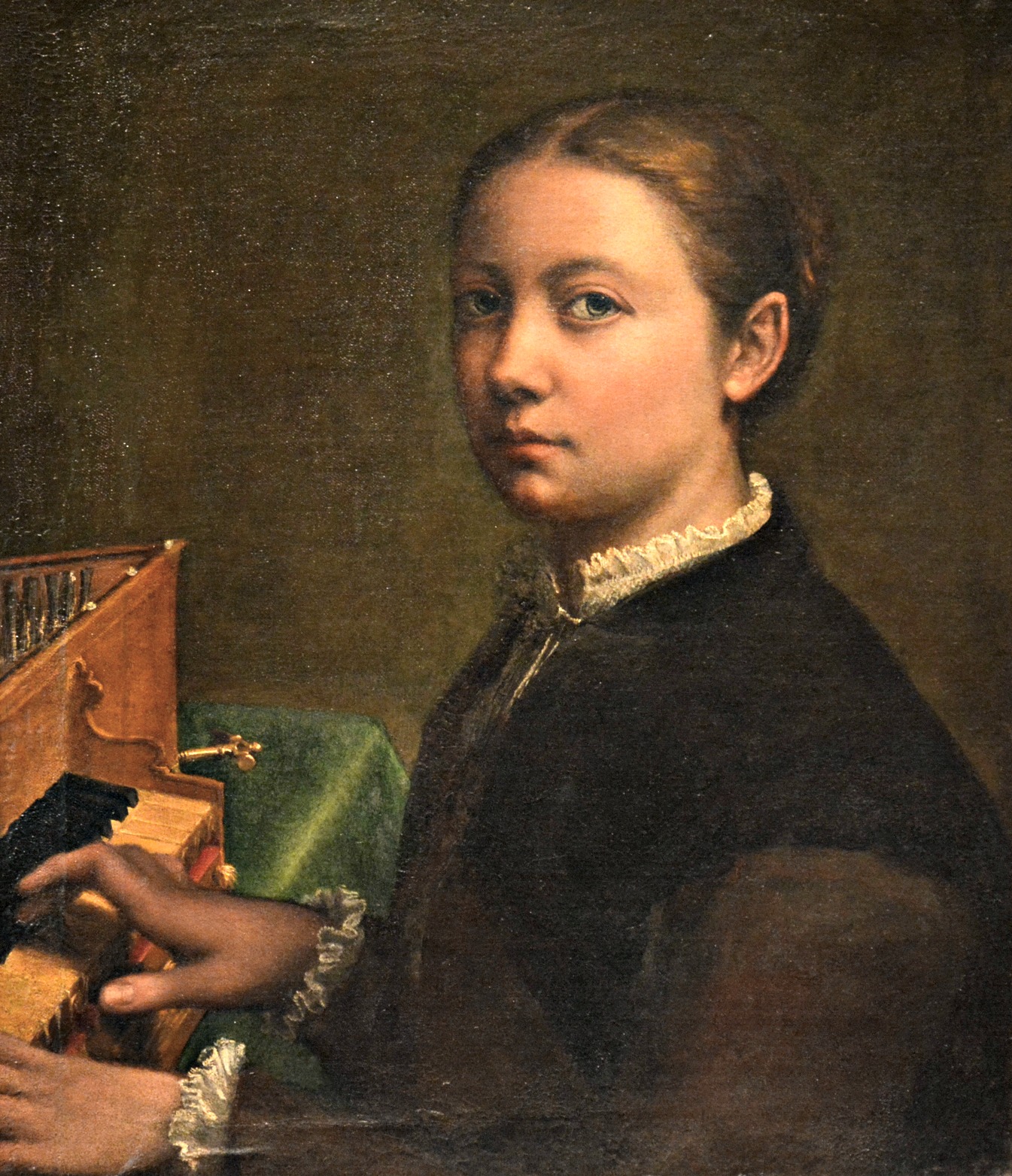
Sofonisba Anguissola was a trailblazing Italian painter of the Renaissance. She was celebrated as one of the first women to achieve international recognition for her artistic talent.
A Noble Birth and a Progressive Education
Born around 1532 in Cremona, Italy, she was the eldest of seven children in a noble family. Her father, Amilcare Anguissola, believed in educating his daughters in arts. He also encouraged them to learn sciences. This was uncommon for noblewomen of the time.
At age 14, Sofonisba began studying painting under Bernardino Campi, and later with Bernardino Gatti (Il Sojaro).
Her extraordinary talent soon caught Michelangelo’s eye. He was so impressed that he mentored her from afar. He encouraged her to develop her craft.
Despite societal constraints that frowned on women becoming professional artists, her father’s support allowed her to continue honing her skills.
Royal court
In 1558, her reputation grew across Italy. As a result, King Philip II of Spain invited her to join his court in Madrid.

There, she served as a lady-in-waiting to Queen Elisabeth of Valois while also painting countless portraits of the royal family. She was not appointed as an official “court painter” but rather held the post of a lady-in-waiting. As a noblewoman, she was not paid for her work; instead, her sitters gave her valuable gifts.
Her works from this period were often unsigned and lacked official documentation. As a result, her paintings were often misattributed to male artists working at the court.
Although she was never officially appointed court painter, her work was highly regarded. Her paintings were characterized by her delicate brushwork, naturalism, and psychological insight.
Genoa, Palermo and Van dyck
After the queen’s death, Anguissola married Sicilian nobleman Fabrizio Moncada Pignatelli. After his death in 1579, she moved to Genoa with her second husband, Orazio Lomellino.
In Genoa, she became a highly influential portraitist. She was a mentor to many artists, including Peter Paul Rubens. He copied her work for study.

Even in her later years, she received admiration from fellow painters. She was nearly blind at over 90 when the Flemish Anthony van Dyck visited her in 1624 in Palermo where she had moved with her husband.
He sketched a portrait of her and noted her “very sharp memory and mind”. He famously claimed that their conversation taught him more about the principles of painting than anything else in his life.
Sofonisba Anguissola was highly respected by her contemporaries.
Giorgio Vasari, an art historian, visited her family home in 1566 while she was in Spain. He was so impressed with her work. He wrote, “she has laboured at the difficulties of design with greater study and better grace than any other woman of our time”.
Anguissola died in Palermo in November 1625 at the age of 93.

Anguissola’s legacy
Her life story is a testament to the power of talent, persistence, and a supportive network.
Sofonisba Anguissola’s legacy endures as a pioneering woman artist. Her work challenged societal norms and expanded the possibilities for women in art.
For centuries, Anguissola’s works were often misattributed to prominent male painters of her time. These included Titian, Leonardo da Vinci, and Francisco de Zurbarán.
Modern scholarship, still, has begun to rectify this historical injustice.
Her career was long and celebrated. It shows a monumental triumph over the social limitations placed on women in the 16th century. She also overcame professional limitations.
She was a trailblazer. She became the first internationally recognized female artist of the Renaissance.
She also pioneered new artistic forms, particularly in genre painting, and injected her portraits with remarkable naturalism and psychological depth.
More about Sofonisba Anguissola
*(This postcard is part of a vast collection. An artist amassed it over sixty years ago and stored it in a wooden box).
Leave a Reply