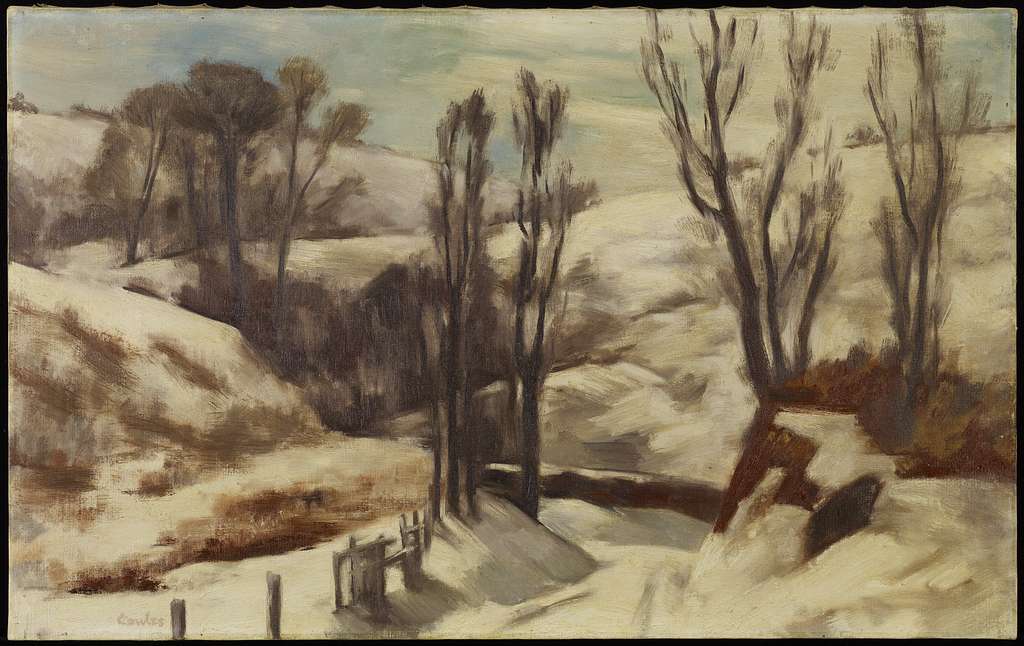
Russel Cowles (1887–1979) was an American artist master of reinvention whose career spanned continents, styles, and decades, blending classical rigor with modernist freedom.
He is celebrated for his diverse body of work—landscapes, genre scenes, murals, and figure paintings—that vividly captured the evolving spirit of modern art.
Education and Early Influences
Cowles was born in Algona, Iowa into the influential Cowles family of newspaper publishers.
His artistic spark was kindled early by his mother, who was a dedicated student at the Art Institute of Chicago.
Growing up amidst Iowa’s sweeping landscapes, Cowles developed a deep love for his native scenery. This theme would influence much of his work.
He graduated from Dartmouth College in 1909. Then he immersed himself in the European art world. He studied in Paris and at the American Academy in Rome.
Back in the U.S., he trained at the National Academy of Design. He also studied at the Art Students’ League in New York. There, he assisted muralists Douglas Volk (1856-1935) and Barry Faulker (1881-1966).
These formative years gave him a solid foundation in both academic and decorative traditions.
A Life of Travel and Transformation
Cowles’ artistic evolution was shaped by his global travels.
From China, Japan, and Java to Egypt, Greece, and India, he absorbed diverse cultural aesthetics, which enriched his visual vocabulary.
Cowles reflected on those formative years. He said: “Travel opened my eyes to a world of colors. I experienced diverse cultures and ideas. These experiences forever transformed my approach to painting.”
His Prix de Rome fellowship (1915–1920) and time in Europe deepened his understanding of classical art. His exposure to the Armory Show of 1913 sparked an appreciation for abstraction and modernism.
By the 1930s, Cowles was part of the Santa Fe art colony. He mingled with modernist peers like Andrew Dasburg and Marsden Hartley.
His work began to reflect a synthesis of East and West, tradition and innovation. Critics praised his ability to simplify form and achieve perfect balance — “essentially a realist,” yet never bound by convention.

Exhibitions and Legacy
Cowles, a master of reinvention, believed that “Art is a dialogue between memory and imagination.” This dialogue constantly reshapes the world around us. This philosophy guided his lifelong pursuit of capturing life’s beauty.
His mastery bridged styles from neoclassical grandeur to abstract innovation, embodying a poetic sensibility deeply rooted in his personal experiences.
Critics praised his landscapes, remarking, “Cowles’s work elevates the landscape into poetry—each brushstroke a reflection of nature’s silent lyric.”
The New York Times wrote in 1950: “Cowles is eminently a painter’s painter who has contrived to blend in his work something of the essential abstraction of the Orient with something of the richness of color and deeply rooted organization of Renaissance masters, al- ways from a highly modern view- point.”
He exhibited widely. He held solo shows in over 40 venues. These included the Art Institute of Chicago, Denver Art Museum, Corcoran Gallery, Pennsylvania Academy of the Fine Arts, and the Whitney Museum.
He was a member of the Century Association and a MacDowell Fellow, affirming his stature in American art circles.
Today, his works reside in institutions like the Denver Art Museum. They are also in the Terre Haute Museum. These institutions preserve his legacy for future generations MacDowell.
Cowles passed away in New York City in 1979. He left behind a body of work that reflects a lifetime of curiosity, craftsmanship, and cultural dialogue. His legacy is a luminous artistry rooted in exploration, nature, and poetic truth.
*(This postcard is part of a vast collection. An artist amassed it over sixty years ago and stored it in a wooden box).
Leave a Reply