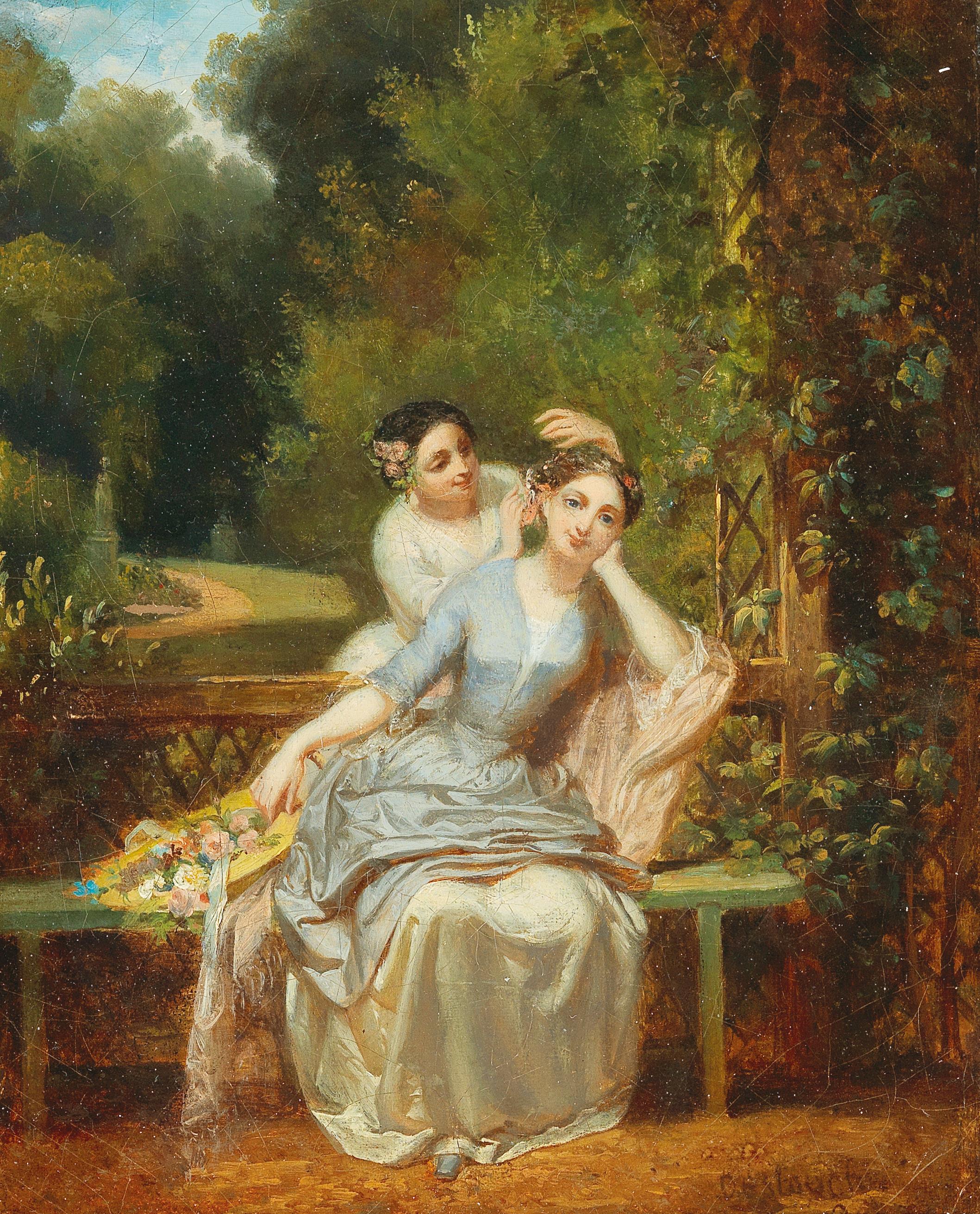
“Art is the reflection of the soul of a nation”
(Paul Emile Destouches)
Paul-Emile Destouches (1794-1874) was a distinguished French painter whose works mark a pivotal era in the evolution of modern art.
His career included grand historical dramas. He also created tender genre scenes, literary illustrations, and orientalist fantasies, reflecting the shifting tides of 19th-century art. His works offer a vivid lens into the emotional and cultural currents of 19th-century France.
Early Years
Paul-Emile Destouches is born in Paris in 1794, son of a painter about whom little is known.
In early 1800s, he studies at the prestigious Collège Louis‑le‑Grand. Then, in 1811, he apprentices under Pierre Guérin (1774-1833). Fifteen months later, he was placed in the studio of Jacques-Louis David (1748-1825) and then in that of Antoine-Jean Gros (1771-1835).
Destouches makes a debut at the Salon in 1817. He presents two ambitious works: Diana of Poitiers Imploring Her Father’s Mercy and Belisarius Giving Alms. He becomes a regular exhibitor at the Salon till 1941.
Two years later, in 1819, he exhibits Resurrection of Lazarus and wins a gold medal. He receives a state commission for the Martyrdom of Saint Cyr and Saint Julitta.

Troubadour Style
Destouches paints a portrait of Louis XVIII in 1820. In the coming years, he creates Troubadour‑style works celebrating medieval French history through dramatic, anecdotal storytelling. Among these works Charles V in His Convent and Marie Stuart in the Loch Leven Dungeons.
“Art, for me, is the poetry of the brush—a symbol of the passions and the history that shape a nation.”, he noted.
In 1827, he exhibits literary illustrations at the Salon, including The Marriage of Figaro and Love the Doctor. The two works were hits at the Salon, showcasing his flair for theatrical storytelling.
`In 1831, he shifts toward genre painting, embracing everyday dramas and social commentary, abandoning the Troubadour. He painted The Interrupted Contract, followed by The Broken Contract, The Orphan, and The Departure for the City. These works explored rural hardship and urban migration with quiet empathy.
“His genre scenes and historical paintings breathe life into familiar subjects, making history both personal and accessible”, noted a 19th-century critic.
His true gift lay in the delicate, familiar subjects he preferred.
“Destouches excels in portraying the human heart with tenderness and a touch of poetic nostalgia, capturing the very spirit of France’s past”, wrote an art historian.
During the 1830s, Destouches explores Orientalism producing romanticized visions, with works like Scheherazade and Selam.

Final Salon
His final Salon participation was in 1841. Illness begins to limit his output. His works gain wide circulation through engraver Georges Maile’s steel‑plate reproductions.
During the late 1840s, his reputation waned. But he continued working quietly behind the scenes, capturing landscapes and crafting caricatures. Few works are known after 1840.
He had poor health. As a result, he abandoned in 1842 a project about the principal French painters of the late second half of the 18th century.
A rare drawing surfaces at auction in 1872, showing his continued dedication late in life.
Destouches dies in 1874 in Paris, largely forgotten. He left behind a rich and varied legacy.
He had a fairly diverse career. He created several caricatures for newspapers and landscape drawings. He composed texts for musical pieces. He even published an Epistle to Nicolas (Poussin) in 1819.
A Modern art scholar wrote: “Though his style fell out of fashion, Destouches’s works continue to resonate through their sincerity and delicate craftsmanship.”
Several of Destouches’s works were popularized through engraving. This was notable due to the excellent engravings by Georges Maile. He began using steel plates and increased print runs to tens of thousands.
His artistic legacy remains a testament to a master who balanced the intimacy of everyday life with the grandeur of history.
*This postcard is part of a vast collection. An artist amassed it over sixty years ago and stored it in a wooden box.
Leave a Reply