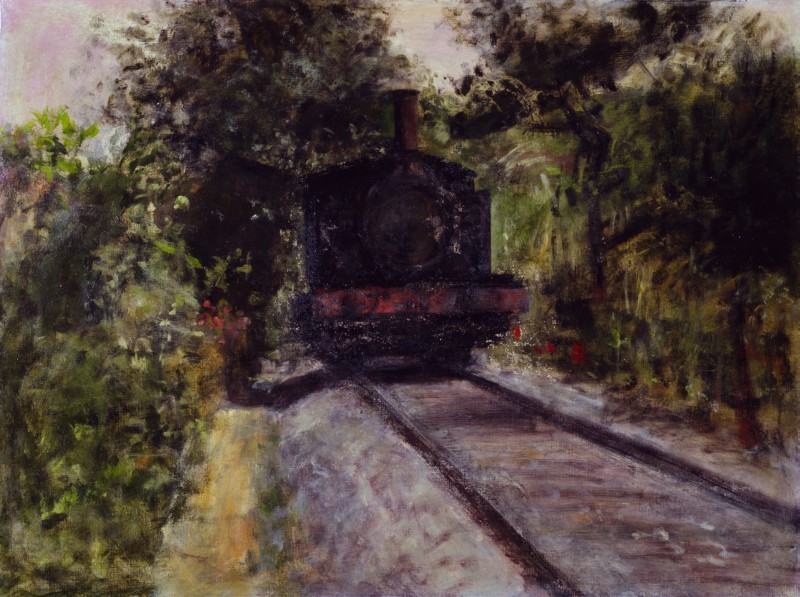
Guido Tallone (1894–1967) was, in Italian painting, a poetic force, who blended modern influences with a deeply personal, expressive style.
The portraitist
Guido was born in 1894 in Bergamo, Italy. His father was Cesare Tallone (1853-1919), a renowned 19th‑century portraitist. Cesare led the Carrara Academy and later the Brera Academy. His leadership laid the foundation for Guido’s own artistic journey.
Guido studied nude drawing and painting at the Brera Academy of Fine Arts in Milan from 1912 to 1915. After his studies, he served in World War I from 1914 to 1918.
In 1919, he returned to Milan and began his career as a portraitist. But the confines of studio life couldn’t contain his restless spirit.
In the 1920s, he embarked on a series of transformative journeys. The travels take place across Berlin, Paris, Madrid, and North Africa. During these journeys, friendships are forged with cultural icons like Ezra Pound, Ernest Hemingway, and Oskar Kokoschka.
He immersed himself in the masterpieces of the Louvre and Prado. He mingled with avant-garde legends like Andre Masson, Juan Mirò, Otto Dix, Marc Chagall, and Paul Klee. He absorbed their energy and ideas.
Invited by his brother Enea, he moved to Switzerland. There, he painted in 1922 his first fresco for a church in Graubünden, marking a turning point in his career.
Lyrical approach to light and color
In 1923, his first public exhibition was held at Milan’s Society for the Fine Arts and Permanent Exhibition. From 1930 to 1948, he was a regular participant in the Venice Biennale.
In 1943, he sought refuge in Venice during World War II years. While there, he continued to paint. He traveled across Europe and eventually to the United States.
After the war, he spent time between studios in Milan, Burano, and Torcello. He continued to travel across Europe and the United States. In 1948, he had a Solo exhibition at Galleria Pesaro, supported by his brother Ermanno and painter Aldo Carpi.
During the 1950s and 1960s, he created evocative landscapes in Alpignano. There, he inherited a family home. He blended Lombard Scapigliatura with Impressionist influences.
These paintings show his lyrical approach to light, color, and atmosphere. They are not mere depictions of place, but emotional landscapes that invite viewers into a world of memory and reverie.
Guido Tallone passed away in 1967 in Alpignano, leaving a legacy of lyrical, expressive works that bridge tradition and modernity.

Harmony between tradition and modernity
Guido Tallone’s art reflects a dialogue between intimacy and grandeur, tradition and modernity.
For him “Painting is the silent poetry of the soul, a language that transcends words and touches the universal.”
Art critics have praised him as “a luminous bridge between the classical tradition and the modern spirit.”
He is “an artist whose landscapes and figures echo with poetic tenderness. They also reveal profound insight”, noted one art critic.
Guido Tallone’s legacy stands as a testament to the harmony between tradition and modernity. It is expressed through a poetic brushstroke that captures the essence of life and Nature.
* This postcard is part of a vast collection. An artist amassed it over sixty years ago and stored it in a wooden box.
Leave a Reply