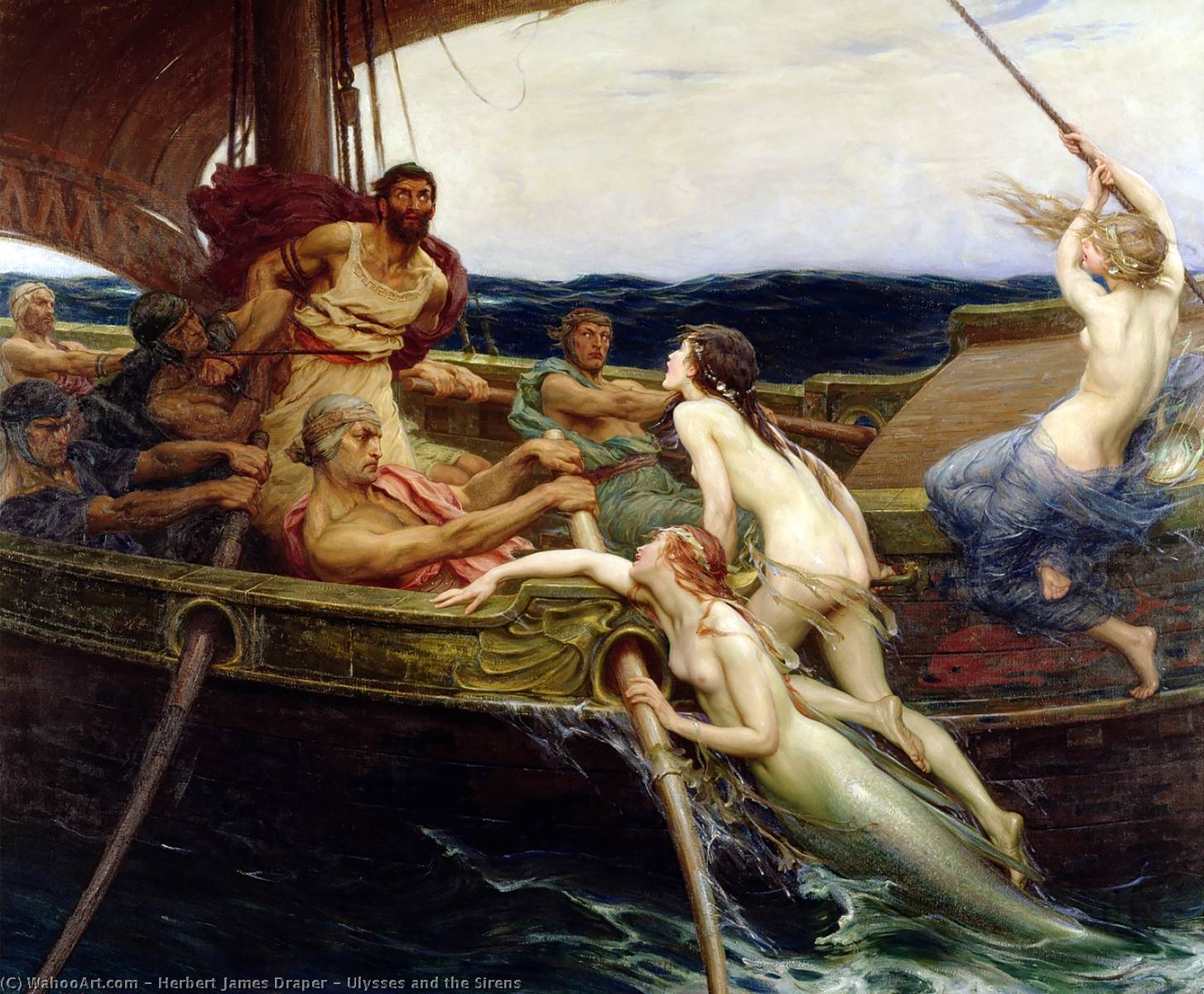
Herbert James Draper (1863–1920) was an English painter of the late Victorian and early Edwardian eras, whose work epitomized the romanticism and classicism of his time. He was a highly successful painter during his lifetime and his work was widely acclaimed. He was known for his grand depictions of mythological and allegorical subjects.
Paris and Rome
Draper was born in 1863 in Covent Garden, London. He was the seventh child and only son of a fruit merchant. He was educated at Bruce Castle School in Tottenham, and his artistic inclinations were nurtured early.
He received his formal training at the prestigious Royal Academy Schools in London, where he quickly distinguished himself.
In 1889, Draper was awarded the Royal Academy Gold Medal and a travelling scholarship. He undertook several educational trips to Rome and Paris between 1888 and 1892. His talent was further honed through this extensive study abroad
In Paris, he attended both the Académie Julian and the École des Beaux-Arts.
This period of rigorous academic training instilled in him a profound mastery of drawing. He gained mastery in composition and anatomy. These skills would define his meticulous and often theatrical canvases.
His immersion in the artistic capitals of Europe was profound. He experienced direct exposure to classical sculpture and Renaissance masters. This combination cemented his devotion to mythological and historical themes.
Draper took part in the annual expositions of the Royal Academy from 1890 on.

The Age of Myth and Beauty
Upon his return to England in the early 1890s, Draper worked as an illustrator, eventually settling in London.
He quickly established himself as a regular and celebrated exhibitor at the Royal Academy from 1890 on.
Draper’s most productive period began in 1894.
He gravitated almost exclusively towards subjects from Greek mythology, classical literature, and allegories. He became particularly renowned for his depictions of sea nymphs, sirens, mermaids, and goddesses. These figures were often rendered nude or semi-nude in shimmering, ethereal settings.
Draper possessed a remarkable ability to depict the human form, merged with a dramatic use of light and color. His figures are often muscular and idealized, but imbued with a sense of melancholic beauty or powerful energy.
His seascapes are particularly notable. They capture the play of light on water with a vibrant realism. This realistic depiction grounds his fantastical subjects.

The Lament of Icarus
In 1900, his most iconic work, The Lament for Icarus (1898), won the Gold Medal at the Exposition Universelle in Paris in 1900.
This monumental canvas depicts a group of sorrowful nymphs mourning the fallen Icarus, whose broken wings lie beside him. The painting masterfully blends anatomical precision with emotional depth and a richly symbolic atmosphere.
The meticulous rendering of the male nude, the delicate drapery of the nymphs, and the dramatic setting of the sunset over the sea exemplify Draper’s technical prowess and narrative ambition.
The Lament for Icarus was later bought for the Tate Gallery.
Other notable works include Ulysses and the Sirens (1909) and The Water Baby (1900).
He was also responsible for the decoration of the ceiling of the Drapers’ Hall in the City of London.

A portrait Painter
Draper was well-known as a portrait painter.
In later years as the public tastes changed and mythological scenes became less popular, he concentrated more on portraits. At a charity auction for the Red Cross in 1918, he offered to paint a child’s portrait. This offer brought in a bid of £250. This amount is equivalent to £15,383 in 2023.
Draper was a successful and well-respected artist at the height of his career. But in his last years, his popularity faded.
He represented an artistic sensibility that was rapidly being eclipsed by the avant-garde movements emerging in the early 20th century. The rise of Impressionism, Post-Impressionism, and later, Modernism, had a significant impact. His academic style and classical subjects began to fall out of critical favor.
Herbert James Draper died of arteriosclerosis in 1920. He passed away in his home on Abbey Road in London.
His work temporarily faded from widespread prominence in the decades following his death. But there has been a significant resurgence of interest in late Victorian and Edwardian art since the late 20th century. There has been a revival of interest in his work on the art market.
The Royal Cornwall Museum’s 2010 auction of his The Sea Maiden was intended to help secure its finances. It also included Ernest Normand’s Bondage. This generated debate about the policy of disposing of art works for this purpose.
Today, Draper is celebrated for his exceptional craftsmanship, his evocative storytelling, and his masterful contribution to the rich tapestry of British academic painting. His works are held in prestigious collections like the Tate Britain and numerous private galleries.
His work stands as a testament to the enduring power of academic classicism and symbolism as the 19th century gave way to the 20th.
See more of Herbert Draper’s art
Source: exhibition catalogues of the Royal Academy, art historical texts focusing on British Symbolism and Academic Classicism (such as works by Christopher Wood or Stephen Jones), and biographical collections of Victorian artists.
Leave a Reply