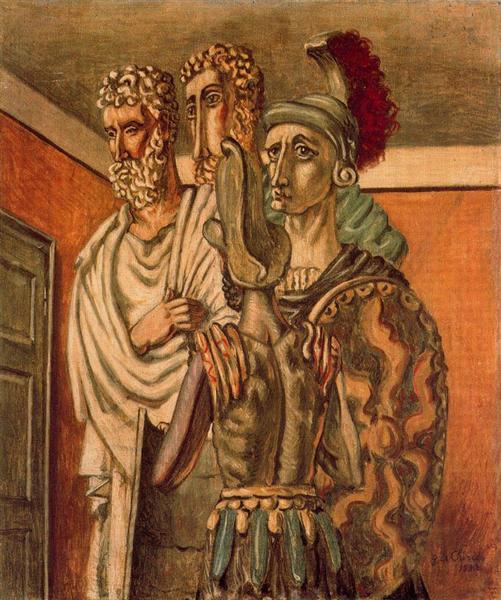
Gladiators were armed combatants in ancient Rome who fought, often to the death, for public entertainment in arenas. However, Giorgio de Chirico (1888-1978) did not frame these warriors as heroic icons, but as “enigmas” of history and memory.
De Chirico painted his “Gladiators” series between 1927 and 1930. He situated them within modern, domestic interiors, rather than expansive arenas.
Through these awkward figures, he crafted a subtle satire on ancient themes in modern ideas. He urged viewers to question the narratives about power and history. His Gladiators are not just remnants of the past. They reflect the contradictions and complexities of his time, acting as a hidden commentary on modern life.
Critics in the 1930s sometimes mistook these for fascist propaganda. De Chirico actually sought to “fool human strength”. He famously wrote about the subject in his only novel Hebdomeros published in 1929, and in various memoirs. He noted: “One must picture everything in the world as an enigma, and live in the world as if in a vast museum of strangeness”.
De Chirico was born in 1888 in Volos, Greece, to Italian parents. His formative years were spent absorbing a mixture of cultures, given his Greek roots and Italian heritage. He pursued art studies in Athens and Florence before moving to Germany, where he enrolled at the Academy of Fine Arts in Munich.
During his time in Munich, Giorgio studied the art of Arnold Böcklin and Max Klinge, and explored the works of philosophers like Nietzsche, Schopenhauer, and Weininger. De Chirico said he was ‘the only man to have truly understood Nietzsche.’
Then, he moved to Paris, where he became associated with the emerging Surrealist movement. However, he later distanced himself from it.
His works from this period often depicted dreamlike scenes with classical architecture and enigmatic statuary. They formed the foundation of his Metaphysical Art movement.
He believed that “everything has two aspects: the current aspect… and the ghostly and metaphysical aspect, which only rare individuals may see.”
The art critic Robert Hughes praised de Chirico’s ability to create “psychic landscapes” that blended classical imagery with modern existential themes, underscoring his innovative impact on 20th-century art.
De Chirico continued to produce influential works throughout his life.
He passed away in Rome in 1978.
“The painting of de Chirico is not painting, in the sense that we use that word today. It could be defined as a writing down of dreams”, wrote the Italian critic Ardengo Soffici, in 1914. Soffici noted: “He truly succeeds in expressing that sensation of vastness, of solitude, of immobility, of stasis which certain sights reflected by the state of memory sometimes produce in our mind, just at the point of sleep.”
More about De chirico’s Gladiators
More about De Chirico
Source: Fondazione Georgio e Isa de Chirico, ArtNews,
Leave a Reply