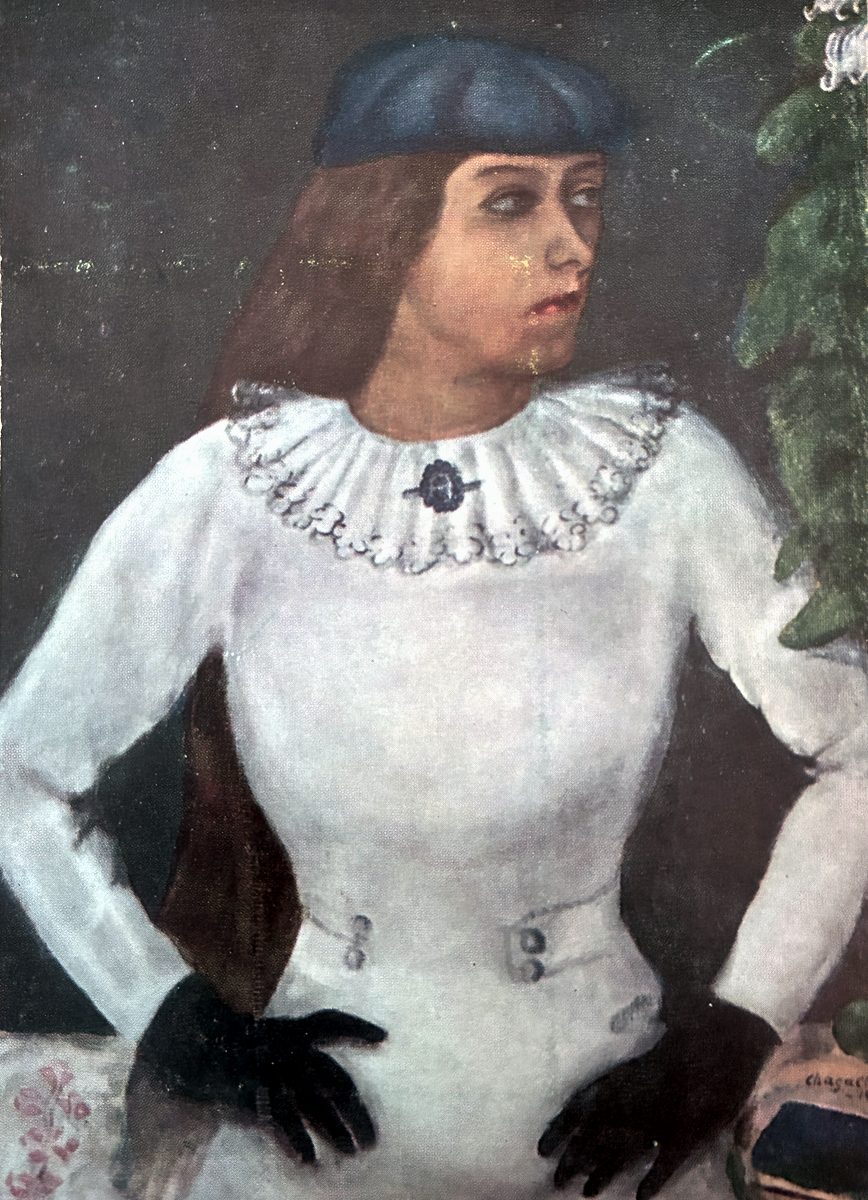
(This postcard is part of a vast collection amassed by an artist it over sixty years ago and stored it in a wooden box)
This is the Portrait of My Fiancée in Black Gloves, painted in 1909 by the Belarusian-French artist Marc Chagall around the time the couple first met in Vitebsk.
Before the Flying Lovers
The love story between Marc Chagall and Bella Rosenfeld is one of the most celebrated and persistent themes in 20th-century art. Their connection was profound, immediate, and served as the central axis around which Chagall’s creative world revolved.
They met in Vitebsk, Belarus, in 1909 when Chagall was 22 and Bella was 14. was a brilliant teenage student from a wealthy, affluent, cultured family of Hasidic jewelers in Vitebsk. Marc was an eccentric, poor aspiring painter. He came from an impoverished working-class family. His father hauled herring barrels.
However, the connection was instantaneous. Chagall described their first encounter as “love at first sight.” He later recalled:“Her silence was mine, her eyes mine. It was as if she knew everything about my childhood, my present, my future, as if she could see right through me.”
Her family was skeptical of the pairing, but Bella recognized his genius immediately.
In 1911, Chagall had moved to Paris to paint, leaving Bella behind with a promise to return. He returned to Vitebsk in 1914 planning only a quick trip, but the outbreak of World War I trapped him in the Russian Empire. The enforced stay allowed them to overcome family resistance and finally marry in July 1915. In 1916 their daughter, Ida, was born.
Muse, Writer and Philosopher
Bella became not just his wife, but his primary muse and spiritual anchor. She became symbol of domestic peace, poetic joy, and spiritual transcendence. In his paintings, she is often depicted defying gravity. She is floating above towns, rooftops, and landscapes.
Beyond being his inspiration, Bella was an accomplished writer, translator and philosopher in her own right. She had studied literature, philosophy, and history in Moscow.
Later in life, she wrote evocative memoirs of their early years Burning Lights and First Encounter, which Marc lovingly illustrated. These memoirs provided essential context for Chagall’s work, offering deep insight into the atmosphere of Vitebsk and their shared cultural upbringing.
During their wartime exile in the United States, Bella contracted a viral throat infection (streptococcal pharyngitis) and died suddenly in upstate New York at age 48, largely due to wartime medication shortages.
Chagall was devastated. He famously ceased painting for nine months, turned his canvases to face the wall, and spent the rest of his life preserving her memory in paint and literature.
The Portrait
In this portrait housed at the Kunstmuseum Basel in Switzerland, Bella wears a theatrical, immaculate white dress featuring a high, ruffled Renaissance-style collar fastened with a brooch, paired with a dark blue beret and contrasting black gloves. The severe contrast between pure white fabric and dark accessories gives her an aristocratic, poised presence.
Her expression is introspective, calm, and aloof. She is gazing out with dark, luminous eyes that reflect her intellectual and sensitive nature.
The deep green plant creeping into the right side of the frame grounds the portrait in the lush, blooming atmosphere of Vitebsk’s summers.
The Kunstmuseum Basel
The Kunstmuseum Basel holds an exceptional collection of works by Chagall, particularly focusing on his “breakthrough years” (roughly 1911–1919). A crucial part of the Basel holdings comes from the collection of Karl and Jani Im Obersteg. This collection includes renowned portraits, such as the Rabbi series, which highlight Chagall’s ability to capture both the individual dignity and the cultural history of his subjects.
The museum hosted Chagall’s first comprehensive museum retrospective in 1933, displaying roughly 270 works. The exhibition marked a pivotal international milestone in establishing Chagall’s legacy across Europe.
These works are considered vital for understanding the evolution of modern art. They demonstrate the transition from traditional figuration to a deeply personal, symbolic language that merged memory, religion, and romantic passion.
More about Chagall: Marc Chagall website, Wikiart
Source: Marc Chagall website, Wikipedia, Wikiart
(Research and drafts were assisted by AI; final content was written and verified by the author)
Leave a Reply