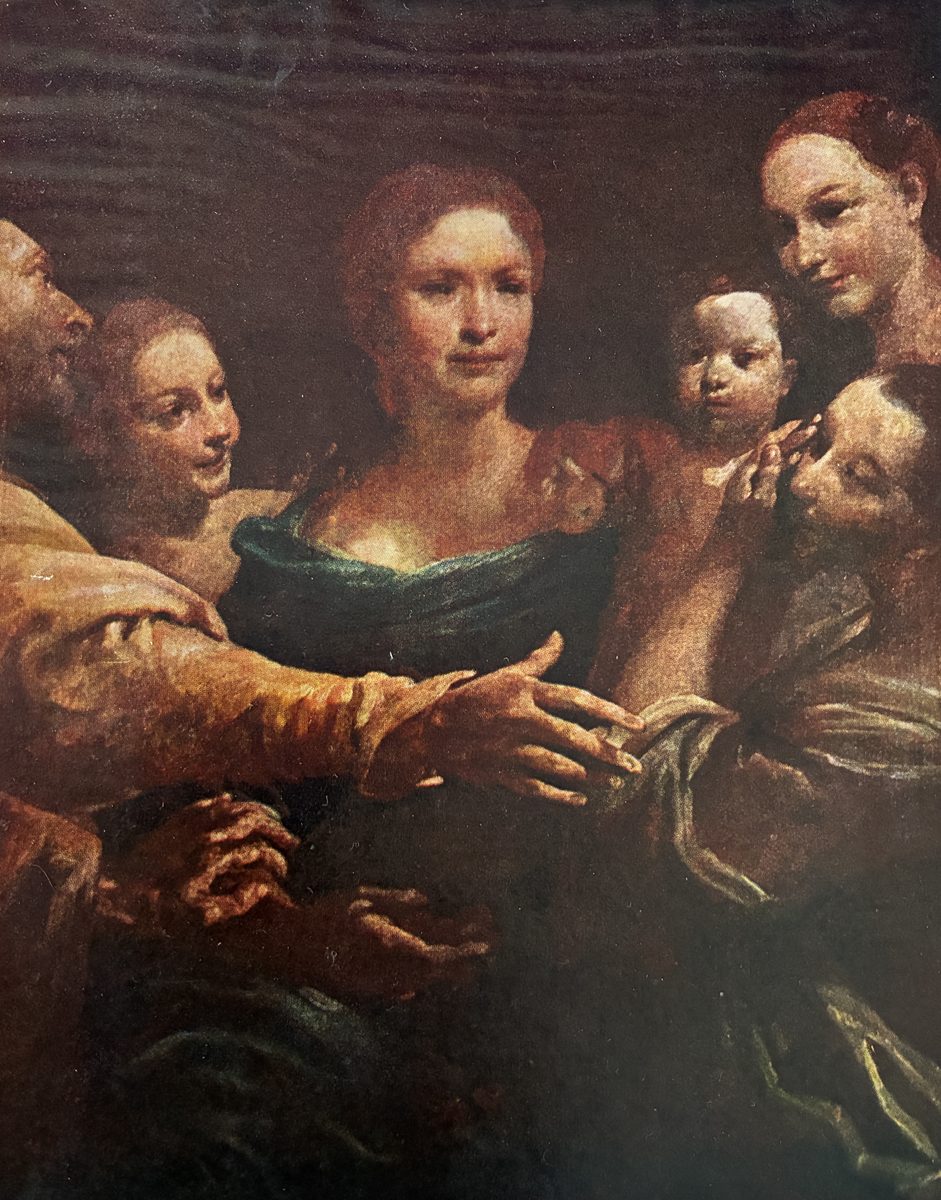
The Family of Zanobio Troni is a significant work by Giuseppe Maria Crespi (1665–1747), an Italian late Baroque painter of the Bolognese School, known for his direct, naturalistic approach to painting.
A Testament of a Close Relationship
The story behind this painting is rooted in the personal life of the artist and his subject.
Zanobio Troni was merely a patron but a friend of the artist. He is captured in this painting created around 1715–1730, alongside his family.
The portrait is a testament to this close relationship. It captures the Troni family in a naturalistic, intimate setting rather than the stiff, formal poses often favored in portraiture of the time.
Historical records indicate that Zanobio Troni was a passionate lute player. This personal detail helps ground the viewer in the character of the man depicted, moving beyond a simple record of appearance to a reflection of his interests and personality.
The painting is celebrated for its naturalism.
It reflects Crespi’s well-known approach to art. He was a pioneer of genre painting, noted for turning away from idealized, formal academic traditions to capture the intimacy of everyday life and the humanity of his subjects.
The original work is housed in the Pinacoteca Nazionale di Bologna in Italy.
Who was Zanobio Troni?
Zanobio Troni was an 18th century silversmith originally from Bologna. He is best known for his religious metalworks, particularly his exquisite decorative reliquaries.
His most prominent surviving masterpieces are housed in the Cathedral Museum in Ferrara, Italy (Museo della Cattedrale di Ferrara).
His legacy as a craftsman is heavily documented in specialized art histories focusing on 18th-century Bolognese silverwork.
The Medici Collection
Giuseppe Maria Crespi (1665–1747), nicknamed “Lo Spagnuolo” (The Spaniard), was born in Bologna and trained under several local masters. He also studied the work of earlier Bolognese and Venetian painters. He visited Venice and other parts of northern Italy, where he absorbed a looser, more painterly handling of color and light.
In 1700 he opened his own school of painting in Bologna.
In the first decade of the 1700s, Prince Ferdinand of Tuscany became an important patron. The prince, known as the Grand Prince, supported Crespi and acquired his works for the Medici collection.
One example is a small self-portrait on copper that reached Florence in 1708 as a Christmas gift to the prince.
He died in Bologna in 1747.
The Genre Painting
Crespi painted religious and mythological subjects, including altarpieces. He is best known, though, as one of the first Italian exponents of genre painting. He treated humble subjects with dignity and psychological depth.
His work often used dramatic contrasts of light and shadow and a warm, earthy palette.
Crespi also made prints and drawings. His focus on everyday subjects influenced later genre painters in Italy.
Today he is regarded as one of the most original Italian painters of his generation.
Sources: books.google.com, Arts and Cultures, Wikimedia

Every canvas tells a story. Find the one that speaks to you in my store.
Leave a Reply