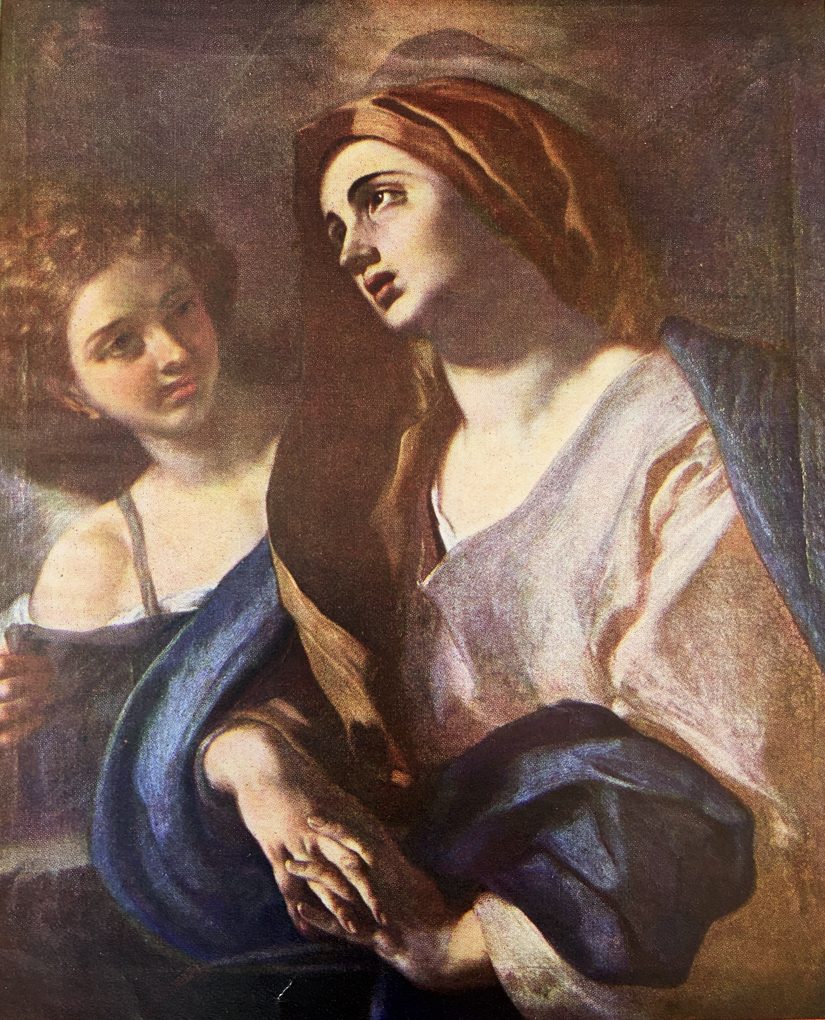
(This postcard is part of a vast collection amassed by an artist over sixty years ago and stored in a wooden box)
Our Lady of Sorrows with an Angel by Francesco Solimena (1657–1747), is a frequent subject painted by this prominent Italian Baroque artist.
The Shared Grief
Our Lady of Sorrows with an Angel (Madonna Addolorata e un angelo) depicts the Virgin Mary in profound grief. The artistic theme focuses on Mary’s seven great sorrows, with the ultimate one being her experience of witnessing her son’s crucifixion and death.
Mary’s upward gaze is one of profound sorrow and communion with God the Father. She is the grieving mother, sharing in her son’s suffering. Solimena relies heavily on realistic human cues of mourning. Her furrowed brow, slightly parted lips, and reddened eyes emphasize her human maternity experiencing a divine tragedy.
The angel is there to provide divine comfort to Mary in her anguish. The angel’s gentle expression and supportive gesture emphasize the depth of Mary’s pain, acknowledging that her sorrow is so great that it requires celestial support.
The painting’s power comes from its focus on this shared grief. Solimena masterfully portrays the connection between the human mother and the divine messenger, united in mourning the death of Christ.
Mary is traditionally swathed in a deep blue mantle, representing her purity, heavenly status, and her role as the Queen of Heaven. Underneath the blue mantle, a white cap closely frames her face. This stark white element draws the viewer’s focus directly to her pale, tear-streaked skin and illuminated sorrow.
Art as Emotive Faith in the Catholic Tradition
“Our Lady of Sorrows” is a traditional Catholic title for Mary.
Following the Council of Trent, the Catholic Church aggressively promoted art that could emotionally engage ordinary people to strengthen their faith against Protestantism. Artists were tasked with creating images of intense emotional power.
Solimena’s Mater Dolorosa perfectly answered this call. He isolated Mary’s grief, making her intense maternal suffering directly relatable to a viewer’s everyday human struggles. He extracts her from the broader historical narrative of the Crucifixion to create a close-up, highly focused emotional devotional piece.
A Booming Market
Francesco Solimena painted Mater Dolorosa to fulfill the theological demands of Counter-Reformation, but also to satisfy the booming market for private devotional art in 18th century Europe.
During the late Baroque period, wealthy aristocrats, religious orders, and merchants eagerly commissioned smaller, intimate paintings for their private chapels or bedrooms.
The thriving mercantile class in Naples and Venice desired status symbols. Owning a “Solimena” was an ultimate mark of cultural sophistication. Private collectors eagerly purchased smaller oil panels.
In southern Italy and Spain, local religious brotherhoods and the cult of Addolorrata (the Sorrowful Mother) were experiencing a massive wave of popularity. The recitation of the Rosary, particularly the “Sorrowful Mysteries,” was an essential daily practice.
Solimena capitalized on this cultural focus, producing distinct, autograph variations to cater to these specific devotional trends.
He painted several variations of this popular theme during his career. He often painted the Mater Dolorosa as a matching pair (diptych) alongside a painting of Christ crowned with thorns.
Many smaller versions were generated by his workshop for the open market. However, prominent versions were commissioned by high-ranking clergy and churches.

The Workshop
During the late 17th and early 18th centuries, Solimena ran one of the most organized and profitable artist workshops in Europe.
He received commissions from the Holy Roman Emperor Charles VI in Vienna, King Philip V of Spain, and Louis XIV of France. Powerful Neapolitan religious orders (like the Jesuits, Theatines, and Oratorians) commissioned massive altarpieces and frescoes for Counter-Reformation strongholds.
Furthermore, high-ranking clergy, such Cardinal Vincenzo Orsini who later became Pope Benedict XIII, demanded intimate, highly emotional devotional works for their private worship spaces.
From Baroque to Rococo
Francesco Solimena (1657–1747), nicknamed L’Abate Ciccio, was born in Canale di Serino. He received his initial training from his father, the painter Angelo Solimena. After moving to Naples in 1674, he immersed himself in the city’s vibrant artistic world.
By the turn of the 18th century, Solimena was the undisputed leader of the Neapolitan school. His studio functioned as a de facto academy, attracting and training a generation of painters from across Europe. He was exceptionally prolific. He also excelled as a portraitist, capturing the status and psychology of his aristocratic sitters.
Solimena amassed a considerable fortune and lived like a prince. His long and successful career bridged the gap between the high drama of the Baroque and the lighter elegance of the emerging Rococo style.
He died in 1747, leaving behind a legacy as the last great master of the Neapolitan Baroque.
His dramatic, elegant, and highly sought-after work defined the artistic landscape of Naples for more than half a century, making him one of the most influential European artists of his time.
More about Francesco Solimena: Invaluable, Sphinx Fine Art,
Source: Ad Imaginem blogspot, Galeria de las Colecciones reales, Wikipedia, Sphinx Fine Art
(This post was prepared with the assistance of AI and reviewed by the author)
Leave a Reply